


The manufacturer: Charles Kim, Turbo Air Inc
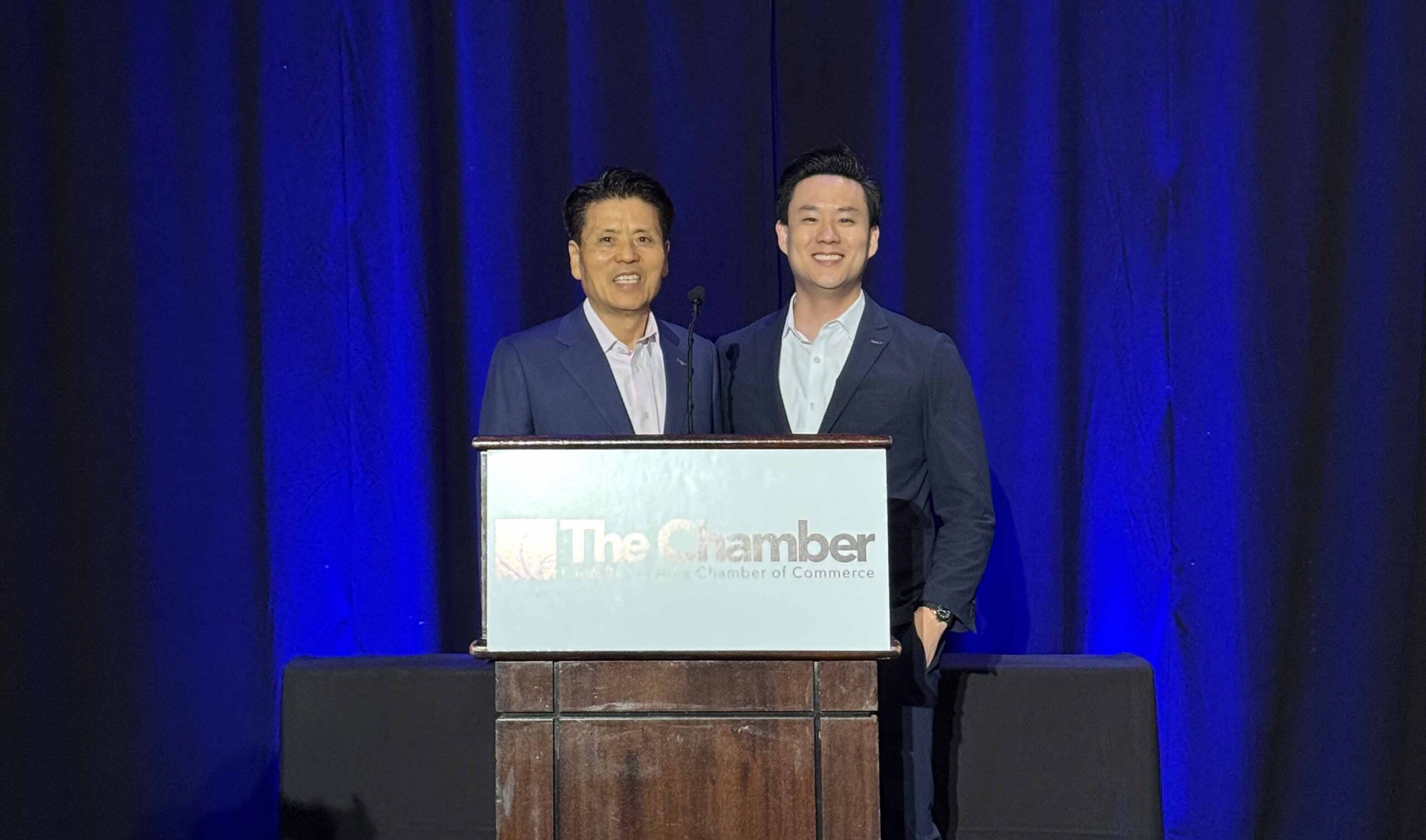
Turbo Air Inc.’s Charles Kim (pictured left with his father Brian) may be currently serving as director of national accounts in the family business his father started in 1997 but in reality, he has been working towards this ultimate ascent to the top of the business his father Brian Kim founded in 1997 for the past 12 years.
On paper he is responsible for large chain accounts, including CVS, 7-Eleven, PepsiCo and Burger King. In reality it looks a little bit different. “I wear a number of hats within the organization, ranging from marketing to quality control and product development and that is by design,” he explains. “My father wants me to gain as much experience across the organization to prepare me to be the future leader of Turbo Air.”
Having emigrated from Korea in 1986, Brian Kim arrived in the US with $1,000 and started to build his new life. He had been a refrigeration mechanical engineer in Korea and started working as a refrigeration tech in his new country. Once he saved up enough money, he opened an equipment dealership before launching Turbo Air.
As for Charles Kim, he had chosen a different route, going into banking after graduation. In December 2014 his father showed up at the bank having handed in his son’s resignation and announced he would be joining the family business.
Kim acknowledges it took him time to adjust to this new scenario – his interest had lied in psychology and technology. “It was a big shock and I think it took me a few years to assimilate, but ultimately my job is not to sell, design or manufacture refrigeration. It is to provide solutions to our clients.”
There is no sign of lingering doubts today. Kim is appreciative and respectful of what his father has achieved. “He sacrificed a lot over the years to build the business, and he has set an example to me as he set the bar for someone who has a very clear vision of what it means to be successful in business and as a father.”
Talent behind technology
He is clear that technology has been key to the evolution of the manufacturing sector, reflecting on the changes that took him from using a pager in high school to advanced automation in his work world. The direction is clear. “As part of the next generation who will lead the foodservice equipment manufacturing sector, I’d like to implement more of those innovations. Let’s not use the pager, let’s use the smart devices, tools like automation, AI, machine learning, anything that can improve the quality of the products that we’re building,” says Kim.
But technology, he says, is only one piece of the puzzle. “Technology is no use without the talent behind it and I see more younger talent and how they are participating with their own twist,” he says. “They are implementing fresh ideas and embracing their uniqueness and injecting it into their environment and that will shape the industry.”
For so many years, a refrigerator has been simply “a box,” says Kim, and “it’s time we bring in a new generation that will challenge how we do things and the function of our products.”
One of many voices
The hope is to be one of many voices that champions for “really drastic industry changes and really advocates for the younger talents to have a voice,” he says. “I want to give them the space to provide their input and reshape our industry, whether that’s from design or technology.”
As to when he will step into the main role heading up Turbo Air, there is no plan and it’s a point he addresses with sensitivity. When it happens it happens, he says. “I want to be respectful to everything that my dad and his generation has done, I would never want to discredit that,” says Kim.
“While he’s here, I still expect great things and I want him to achieve the best at everything that he wants to achieve within his within his career. I just want to be there to support him while that initiative – and his dream – is still in place.”
The consultants: Emerging Professionals in Consulting (EPiC)

The worldwide Emerging Professionals in Consulting (EPiC) network originally began in The Americas Division (TAD) of FCSI and has gone on to evolve and grow in different iterations over time. Today, it has expanded across all three regions to become a global network of next-gen foodservice consultants who are passionate about reshaping the future of FCSI and the wider foodservice and hospitality industry.
Alison O’Hearn who works with Cini-Little Inc was the first chair of EPiC in TAD and she has learnt a lot from meeting with equals. “For me, the in-person events are extremely important, because so many of us work remotely that we don’t even see our own companies, let alone each other. I think having the young professional group, and getting together in person from time to time is really important.”
Juan Umbert FCSI, CEO of Makeat in Barcelona, Spain, is a member of FCSI’s Iberia chapter, the most recent addition to the FCSI EAME Division. He welcomes the invitation to join a group of likeminded professionals. “At the FCSI EAME Conference in Liverpool, I was really amazed to see how many people are working hard to become an industry that is big, beautiful and connected, which was really new to me,” he says.
With a background in hospitality, Umbert has dedicated himself to entrepreneurship and runs Makeat with his business partner, exploring the innovation side of the gastronomic. “Inspiration comes through action. We are already exploring the future,” says Umbert. “EPiC now feels like a connection between the past, the present and the future and I’m really excited to see what’s coming.”
ICON to EPiC
There has been a group for young and emerging consultants in TAD for at least 13 years, according to Penny Price, director of member services for FCSI The Americas. While the mission has largely stayed the same, leadership and participation have shifted over time as members, who must be under 45, continue to progress through their careers as FCSI consultants, she reflects.
In the early days, the group was called ICON and was led by FCSI The Americas veterans Eric Norman FCSI, Christine Guyott FCSI and Kristin Sedej FCSI, with Norman sitting on the board of trustees as the ICON rep. For several reasons, the ICON board seat was removed, which made it difficult for younger members to become active outside of Conference Planning Committees.
“Over time, the ICON group resurrected as the Committee for Emerging Consultants (C4EC) and only lasted a few years due to a lower number of younger members available and lack of leadership opportunities,” says Wade Koehler, executive director of FCSI The Americas.
In recent years, when more younger members started joining the current iteration was launched and rebranded as EPiC, with a more advanced.
Today, EPiC spans the three divisions, with EAME formally launching its group at the FCSI EAME Conference in Liverpool in May 2026, and APD currently getting theirs underway. In Asia Pacific, EPiC will be spearheaded by Australian consultant Gerard Bloor, an FCSI Senior Associate, with support from Bruno Magro FCSI in Shanghai. “As younger consultants, we are ready to welcome and encourage more emerging members to FCSI,” says Bloor. “Taking the lead from The Americas Division and Alison O’Hearn, who was a key founder, we are adapting the amazing EPiC initiative in APD to provide a platform for consultants under 45, and prospective consultants considering this career path.”
The APD team currently has 58 consultants who belong to EPiC.
In EAME, Dilianne Reinders – van Nistelrooij, working with the FCSI EAME office, oversees the coordination of EPiC, which has been under construction since autumn 2025. Following an initial informal exploratory session with a small group of EPiC members in February 2026, the official EPiC Kick-Off Workshop took place in March. Since then, the network has grown to 61 active members within the EAME region.
Autonomy and leadership
Currently, four members act as interim spokespeople for the group: FCSI Associate Moritz Katz, Giorgia Lardner FCSI, Kevin Schindler of FCSI Allied member Hobart, and Cédric Gaglio of FCSI Allied member Matfer Bourgeat. The FCSI EAME office leads the coordination of the EPiC network.
“For the EPiC groups, I would love to see a trust that ensures a form of autonomy, leading to more responsibility,” says Katz. “The new generations want to keep building things and to do that we need the platform to be active and get things done.”
It remains clear that, whatever generation a consultant may belong to, networking, connecting and building contacts is a crucial strength at the heart of everything FCSI does, and will be continued by EPiC to ensure the opportunities are passed on for the next cohort.
“EPiC is a platform that connects new solutions with the ecosystem,” says Umbert. “Changes are happening so fast, and while trying to adapt your business, we can try to figure it out and develop processes that help the industry. This is what I’m really excited about. Where I find myself most comfortable is in the unknown.”
The campaigner: Dev Sharma, Biteback, UK

The next generation is known for its tenacity in driving positive change. Dev Sharma exemplifies this as a leading voice in health and environmental issues, with global impact as a campaigner on some of the biggest issues facing young people, especially food.
“I grew up in Leicester, in the East Midlands in England, and as a teenager I could see how the food environment around me was shaping mine and my friends’ health,” says Sharma. “There were chicken shops on every corner near school, junk food ads followed us everywhere online, and good food was often the expensive, inconvenient option.”
At 14, Sharma (pictured below) co-founded Bite Back 2030 with renowned cook and food activist Jamie Oliver, campaigning against the flawed food system, speaking directly to decision-makers and taking action in schools, communities and national media.
“I believed young people deserved a seat at the table on decisions shaping our health,” says Sharma. “That grew into a six-year campaign for the UK’s ban on online junk food advertising, which came into force this January. Bite Back proves young people can change the system, rather than just being told to change themselves.”
Access to the better options
For Sharma, the biggest challenge is that healthy options remain the hardest to access. “Junk food is cheaper, more available and more heavily marketed than good food, and the cost of living has made that worse. Young people need proper food in schools, and decision-makers who treat them as partners, not a problem to fix.”
“My favorite moments are those watching a teenager who’s never spoken publicly before stand in front of ministers or industry leaders and shift the conversation through sheer lived experience. We’re not asking for permission to be heard any more.”
Sharma has spoken at the UN and the UK’s House of Commons, and is a dedicated advocate for holiday hunger and free school meals, with efforts recognized by the Diana Award and praised by Jamie Oliver. “We live in these food environments every day, so we spot what policymakers miss, and we have no stake in defending how things have always been done.”
School meals: the next frontier
School food is the next big frontier. Free school meals extend to every child in a household on the government benefit Universal Credit from September 2026 – equating to around four million children, or 40% of pupils in England.
“At the same time, the government is overhauling the School Food Standards for the first time in over a decade, with proper monitoring at last, and breakfast clubs are rolling out across primary schools,” says Sharma. “My focus, through the School Food Review coalition and the Food Education Network, is making sure funding reaches school kitchens, the food is genuinely good, and food education is embedded in the school day.”
“Getting a healthy meal at school shouldn’t depend on your postcode or your parents’ pay stub. For the first time in my lifetime, we have the chance to make that real.”
The chefs
Chudaree “Tam” Debhakam

The owner and head chef of Baan Tepa Culinary Space in Bangkok, still in her early 30s, has already made her mark with a commitment to the community around her. She was the first Thai woman to be awarded two Michelin stars and won the Michelin Young Chef award in 2024. In her fine-dining restaurant she champions farm-driven cuisine and has worked as Chef Ambassador for Thai Harvest SOS and the United Nations Environment Programme sustainability campaigns, promoting food waste reduction initiatives.
Marc Roca Payet and Martí Roca Tirado
The next-generation culinary talents have entered the kitchen at storied restaurant El Celler de Can Roca. The cousins, two years apart, are following in the footsteps of their fathers, Josep and Joan, two thirds of the brothers who opened the Girona restaurant 40 years ago this year. This way the three-Michelin starred restaurant, twice named the best in the world is cementing its status as a genuine family enterprise. The two grew up surrounded by gastronomy and have described el Celler as the omnipresent big brother throughout their life.
Ioannis Liapakis
The 2025 winner of the European Young Chef award forms part of a movement of young chefs who have chosen to focus on place over technique, celebrating their local ingredients and culinary heritage. The young Cretan chef cooks the food of the land he grew up in and he won the award by cooking Erevinthos, a dish of chickpeas and rice deeply rooted in the Mediterranean culture and his home island.
“For me, tradition is not a boundary – it’s a foundation,” he says. “It gives us the roots to create, to innovate, and to carry our culture forward through every dish we serve.” At 23, Liapakais can truly be said to be a rising star and this year of 2026, when Crete is a designated European region of gastronomy, might just be his time to shine.
Juan Camilo Liscano
After learning in the kitchens of the world’s gastronomic hotspots, Juan Camilo Liscano returned to Miami and opened Palma in Little Havana by borrowing money from his dad and raiding his savings account. His Colombian heritage and globetrotting training come together in the farm-driven menu at the small 25-cover restaurant. It earned him the recognition of Florida Young Chef award for 2025 by the Michelin Guide.
Rasmus Munk
He may have already been named the best chef in the world twice and hold two Michelin stars at Alchemist in Copenhagen, but it is easy to forget that the Danish chef is still only 34 years old. He has been compared to a young Ferran Adriá who set new standards and pushed the boundaries of where a restaurant could feasibly go and though ‘One to watch’ may miss the mark; but Munk will surely shape
the future of the kitchen for years to come.
Lauren Hurrell and Tina Nielsen


